Personalized Medical Care & Dedicated International Patient Concierge
Medical Guide
Rhinoplasty Before and After: 100+ Real Patient Results Gallery
Explore 100+ real rhinoplasty before and after results, showcasing natural-looking transformations across diverse patient cases. View detailed outcomes, surgical precision, and realistic expectations from expert procedures.
Schedule a Consultation
Introduction
The decision to have rhinoplasty is deeply personal and one of the most important visual decisions you'll ever make about your face. If you're considering a nose job, you're likely wondering one critical question: What will my result actually look like? Not what the clinic promises. Not what marketing shows. What real patients actually achieved naturally, subtly, honestly.
The challenge is that most patients researching rhinoplasty feel paralyzed by uncertainty. You've scrolled through before-and-after galleries that all look the same. You've seen results that look "done" obviously surgically altered in ways you'd never want. You've wondered if natural-looking rhinoplasty is even possible, or if every nose job looks somehow artificial once you know what to look for. The truth is: finding real, diverse, honest rhinoplasty results is harder than it should be.
This guide showcases 100+ authentic rhinoplasty before and after results from Baroko Plastic Surgery organized by specific concerns, patient demographics, and procedure type so you can find cases that match your goals. By the end of this gallery guide, you'll understand As a board-certified ENT specialist with 20+ years of rhinoplasty experience and 200+ procedures performed annually, Dr. Jun Kim has developed a philosophy of harmony-first, implant-free rhinoplasty that produces results patients are genuinely proud to show (or keep private, as they choose). The cases in this gallery represent this commitment to natural outcomes that look like genetic good luck, not surgical intervention.
What Natural Rhinoplasty Before and After Results Look Like
Defining "Natural" in Rhinoplasty Results
At Baroko, natural results means the nose looks like it was always part of your face no one should wonder if you had surgery unless you tell them. This philosophy is fundamentally different from the approach many clinics take. Natural results preserve ethnic identity and facial harmony; they enhance what already exists rather than imposing a template that flattens individuality.
The surgical philosophy here is simple: refinement, not transformation; elevation, not reconstruction. When you look at your rhinoplasty before and after photos, the goal is that you see your nose just better. More refined. More in proportion with your face. Your friends might say, Something's different about you, but they can't quite put their finger on what.
What does this mean in practice? It means avoiding the common mistakes that create obviously done noses. Over-rotated tips that point unnaturally upward. Pinched bridges that look narrow and artificial. Visible scarring or irregularities. Asymmetries that catch the eye immediately. At Baroko, we avoid these pitfalls through a combination of surgical precision and conservative aesthetic choices.
The implant-free, autologous cartilage approach enables natural results because the patient's own tissue integrates seamlessly with the existing nasal structure. There's no foreign material, no risk of visible rippling, no sense that something artificial has been added. The cartilage we harvest from your own ear or rib becomes part of your nose; it heals as part of your body, not as an implanted object.
"A successful rhinoplasty should make people wonder if you changed something they just can't quite put their finger on what. That's natural. When someone looks at your nose and immediately thinks 'that was surgically done,' we haven't achieved the goal. At Baroko, we're aiming for 'your nose, refined' not 'your new nose.'" Dr. Jun Kim, Board-Certified ENT Surgeon, Baroko Plastic Surgery
Visual Characteristics of Natural Outcomes
So what does a natural rhinoplasty before and after actually look like? Several key characteristics define results that appear genuinely unmanipulated.
- Nasal proportions are fundamental. The bridge width should relate harmoniously to your face width. The tip projection should balance the bridge height. Nostrils should be symmetrical without looking artificially geometric. When these proportions are correct, the nose feels like it belongs on your face not like it was designed in a vacuum.
- Profile harmony is where the expertise becomes visible. A natural bridge line is smooth and unbroken, without sudden angles or visible irregularities. The tip is refined but not over-rotatedit doesn't point upward unnaturally or create an unnatural angle against the face. Instead, the tip sits at a natural angle that complements the upper lip and chin. This is where tip refinement becomes an art; the difference between a beautiful result and an "overdone" result is often just a few degrees of rotation.
- Front view balance is equally important. The nose should be balanced, symmetrical, and proportionate with your face and cheekbones. It shouldn't dominate your features or disappear into the background. A truly natural result is one where the nose finally feels like part of the overall facial harmony rather than a feature that draws attention to itself.
- Subtle refinement is the underlying principle. The smaller the visible change, the more natural the result appears. When you compare before and after photos of a naturally refined nose, the change is often understated. This is why patience and conservative surgical choices matter so much. A surgeon who over-refines creates a result that's visibly altered; a surgeon who refines conservatively creates a result that looks like good genetics.
- Swelling reality is something many patients don't fully appreciate. Even natural results look slightly thick or unnatural for the first 3–4 months. This is normal healing. Final rhinoplasty before and after results the truly natural-looking ones typically aren't fully visible until 6+ months post-operation, when all swelling has resolved and the tissue has fully settled into its new shape.
- Ethnic and cultural aesthetics matter profoundly. Natural outcomes honor patient heritage. This doesn't mean refusing to enhance an Asian nose or a Latin American nose it means enhancing it within cultural parameters that preserve identity. A refined Asian bridge should still honor Asian facial proportions. A refined Latina nose should maintain the characteristics that reflect the patient's heritage. This is where the philosophy of "your nose, refined" becomes crucial.
Understanding the Timeline to Final Results
One of the biggest mistakes patients make is judging rhinoplasty results before they're actually final. Your rhinoplasty before and after won't look the same at Week 2 as it will at Month 6. Here's the realistic timeline:
- Month 1: You'll see approximately 50–60% of your final result. Significant swelling is still present, especially in the tip and bridge. The nose looks puffy and feels swollen. If you're worried your result is too much or "not right" at this point, wait. This is normal healing, not the final outcome.
- Month 3: The picture becomes much clearer. You're seeing approximately 75–80% of your final result. Most of the major swelling has resolved, though some minor edema (puffiness) remains. At this point, you can begin to see the true shape and refinement of your result. This is when most patients start feeling genuinely happy with their rhinoplasty before and after appearance.
- Month 6: You're at approximately 90–95% of final results. The final contours are settling into their permanent shape. The swelling has resolved almost completely. This is when your result truly looks natural, when people who haven't seen you in months notice something's different but can't quite identify what.
- Month 12: You've reached 100% of final results. Full healing is complete, including the maturation of internal scarring and the final settling of all tissues. Your rhinoplasty before and after journey is complete.
Why does this timeline matter? Because bone and cartilage remodeling takes time. The soft tissue swelling the last thing to resolve is the final barrier between where you are and your final result. Patience is essential. Judging results before Month 6 is premature and often leads to unnecessary anxiety or regrettable decisions about revision surgery.
Primary Rhinoplasty Gallery — Dorsal Hump Removal
What Is a Dorsal Hump and Why Patients Choose to Correct It
A dorsal hump is a bony and/or cartilaginous prominence on the bridge of the nose essentially a "bump" on the profile. For many patients, this is the single feature that has bothered them for years. It's often genetic, though it can also result from previous nasal injury.
In Western beauty standards, a dorsal hump is often perceived negatively. It can affect how you look in profile photos, how your face appears on video calls, and most importantly, how you feel about your own reflection. Some patients have adjusted to it their entire lives; others find it increasingly bothersome as they become more image-conscious in their careers or personal lives.
Here's what matters: correcting a dorsal hump is more than just removing a bump. It's about understanding your face's proportions and creating a bridge line that looks like it naturally belongs to you. Some patients want a completely straight bridge; others prefer a subtle line with gentle curves that maintains some character. At Baroko, we customize the approach to your specific aesthetic goals and unique facial anatomy.
The rhinoplasty before and after cases in this section show how varied dorsal hump reduction can be because "reduction" doesn't mean one-size-fits-all smoothing. It means creating a bridge profile that harmonizes with your face.
"A dorsal hump isn't just about removing a bump—it's about understanding your face's proportions and creating a bridge line that looks like it naturally belongs to you. Some patients want a completely straight bridge; others prefer a subtle line with gentle curves. We customize the approach to your aesthetic goals and facial anatomy." — Dr. Jun Kim
20+ Dorsal Hump Before & After Cases
The gallery below showcases 20–25 authentic rhinoplasty before and after cases, all focused on dorsal hump removal. Each pair includes the patient's age range, primary concern, and a description of the result achieved.
What you'll notice: These cases are organized by patient demographics Western/Caucasian patients, Asian patients, Latina patients, and mixed-heritage patients. This diversity is intentional. You should be able to find cases that match your own nasal features and heritage, because results vary based on the starting anatomy.
Case Example Gallery:
- Case 1: 32-year-old female, prominent dorsal hump with wide bridge → natural bridge refinement, maintained ethnic features, profile harmony restored
- Case 2: 28-year-old male, significant dorsal hump affecting profile confidence → subtle bridge smoothing, maintained masculine contours, natural appearance
- Case 3: 41-year-old Asian female, dorsal hump on flat bridge → ethnic-appropriate bridge enhancement and hump reduction, raised bridge definition maintained
- Case 4: 26-year-old Latina female, dorsal hump with bulbous tip → combined dorsal smoothing and tip refinement, natural profile angle, cultural features preserved
- Case 5: 35-year-old mixed-heritage male, prominent dorsal hump → conservative hump reduction, maintained nasal character, professional appearance at 6 months
Dorsal Hump Reduction + Secondary Concerns
It's important to understand that many patients with dorsal humps also have secondary concerns. A dorsal hump rarely exists in isolation. Often, the wide bridge that creates the hump is paired with a bulbous tip, or the hump is present alongside slight asymmetry.
This section shows cases where multiple concerns were addressed simultaneously. For example: Dorsal hump + wide bridge + bulbous tip refined in single procedure. The good news? All combined procedures heal on the same timeline. Functional breathing is maintained or improved throughout.
When you're evaluating rhinoplasty before and after results that address multiple concerns, remember that the surgeon has had to coordinate multiple refinements. This requires higher technical skill but produces more harmonious overall results. You're not looking at a nose where the hump was removed and the tip was left alone you're looking at a comprehensive facial refinement where all elements work together.
Primary Rhinoplasty Gallery — Tip Refinement & Bulbous Tip Correction
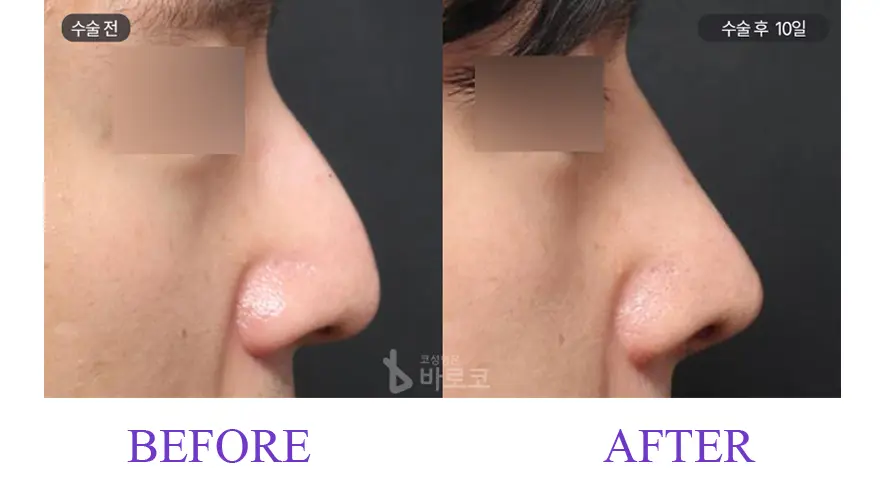
Bulbous Tip and Why Tip Refinement Is Technically Demanding
A bulbous tip is excessive soft tissue in the nasal tip, creating a rounded or overly wide appearance. Many patients with bulbous tips describe their noses as "fat" or "big," even though the bridge and dorsum might be proportionate. The tip is the visual anchor of the nose; when it's bulbous, it dominates the entire facial appearance.
Here's an important truth: tip refinement is one of the most technically demanding aspects of rhinoplasty. There's even a saying in the surgical community: "Anyone can reduce a hump; refining a tip is art." This is because the tip is highly visible, highly complex anatomically, and unforgiving of mistakes. Over-refine it, and you create a pinched, unnatural appearance. Under-refine it, and the patient remains unsatisfied.
At Baroko, tip work is performed with the implant-free, cartilage-based approach. The tip is refined by reshaping and repositioning the patient's own cartilage, not by adding material or creating artificial contours. The goal is a defined, natural-looking tip that projects appropriately without appearing pinched, over-rotated, or surgically done.
The rhinoplasty before and after cases in this section demonstrate this precision. You'll see tips that went from round and bulbous to refined and defined while still looking like a real nose, not a sculpted object.
"Tip refinement requires precision and restraint. The temptation is always to over-refine, to create a pointy, sculptured tip that looks beautiful on its own but doesn't belong on a real face. At Baroko, we refine the tip until it looks like a naturally refined part of your face. That usually means 30–40% less refinement than the patient initially expected." Dr. Jun Kim
20+ Tip Refinement Before & After Cases
This gallery includes 20–25 rhinoplasty before and after cases focused specifically on bulbous tip correction and tip refinement. Cases are organized by specific tip concern: bulbous/round tips, wide tips, over-rotated or under-rotated tips, and asymmetrical tips.
What makes these cases valuable: You'll see front views and base views (looking up from underneath the nose) so you can clearly see how tip width is refined. For Sophia and other patients concerned about their tip, these cases answer the critical question: "Will my tip look natural after refinement, or pinched and artificial?" The answer, in all these cases, is natural.
Case Example Gallery:
- Case 1: 31-year-old female, bulbous rounded tip → refined, defined tip showing significant width reduction while maintaining natural appearance
- Case 2: 29-year-old male, wide tip affecting overall nose perception → tip narrowing with preserved projection, masculine contours maintained
- Case 3: 27-year-old Asian female, bulbous tip on flat bridge → combined tip refinement and bridge enhancement, ethnic proportions honored
- Case 4: 38-year-old female, over-rotated tip from previous surgery → tip lowering and refinement in revision case
- Case 5: 26-year-old female content creator, bulbous tip affecting camera appearance → conservative tip refinement allowing early return to filming
Tip Refinement + Dorsal Work Combined
Many patients need both dorsal hump reduction AND tip refinement. These combined cases demonstrate how Baroko approaches comprehensive primary rhinoplasty. When both concerns are addressed, the result is a proportionate, harmonious nose refined in all dimensions.
The recovery timeline is the same as single-concern cases; healing is unified across the entire nose. But the result is more dramatically improved because the entire profile and front view have been harmonized.
Primary Rhinoplasty Gallery — Bridge Augmentation & Width Correction
Bridge Augmentation and Width Correction
Bridge augmentation is the process of raising or defining the bridge of the nose (the dorsum). This is particularly common in Asian patients with naturally low or flat bridges and this is Sophia's specific concern. A flat bridge is not a defect; it's a normal nasal variation. But for patients who want their bridge more defined, augmentation is the answer.
At Baroko, augmentation is performed using implant-free autologous cartilage the patient's own cartilage harvested from the ear or rib. This is fundamentally different from silicone implant augmentation. Because it's your own tissue, it integrates beautifully and looks completely natural. There's no foreign body rejection risk, no feel of implant material, no risk of long-term displacement or rippling. It's simply your refined nose that happens to have your own cartilage enhancing the bridge.
Width correction is the complementary procedure. Some patients have naturally wide bridges bone structure that creates a wider nasal base. Narrowing a naturally wide nasal bridge requires careful surgical technique. The goal is proportion, not over-narrowing, which can look unnatural and create functional problems.
The rhinoplasty before and after cases in this section show both augmentation (raising a flat bridge) and width reduction (narrowing a wide bridge), often in the same patient.
20+ Bridge Augmentation & Width Correction Before & After Cases
This gallery emphasizes Asian rhinoplasty cases showing ethnic-appropriate bridge enhancement. The cases here are particularly relevant for Sophia and other patients with Asian heritage seeking natural bridge enhancement.
Case Example Gallery:
- Case 1: 26-year-old Vietnamese-American female, flat bridge seeking definition → raised bridge with autologous ear cartilage, ethnic proportions honored, natural appearance
- Case 2: 31-year-old Korean-American female, low bridge with wide base → combined bridge augmentation and width reduction, proportionate enhancement
- Case 3: 29-year-old Filipino-American female, flat bridge affecting profile confidence → subtle bridge raising, maintained soft tissue harmony, no implant
- Case 4: 33-year-old Asian female, flat bridge + bulbous tip → combined augmentation and tip refinement, comprehensive facial harmony
- Case 5: 28-year-old mixed-heritage female, wide bridge → bridge narrowing maintaining definition, ethnic features preserved
Patient testimonials emphasize the impact: "Sophia, 26: 'My bridge is finally defined. I feel like my nose matches the rest of my face now.'"
Implant-Free vs. Implant-Based Augmentation Outcomes
This is a critical section for understanding why Baroko's approach produces superior long-term results. When you compare autologous (implant-free) versus silicone implant augmentation, the rhinoplasty before and after outcomes tell the story.
Autologous augmentation integrates seamlessly. The cartilage becomes part of your nasal tissue Over years and decades, it remains stable, feels natural, and has zero risk of implant-related complications.
Silicone implant augmentation, by contrast, carries small but real long-term risks. Rippling (visible texture through the skin), displacement (the implant shifting position), and extrusion (the implant working its way out) are documented complications that occur in a small percentage of cases. These complications are rare, but they're possible and they're permanent problems.
Baroko uses implant-free exclusively. The results you see in this gallery prove that implant-free augmentation delivers excellent, lasting outcomes. Note: implant-free augmentation may require rib cartilage harvest (more involved than ear cartilage) but the long-term benefit justifies the approach. Rib cartilage provides sufficient volume for even significant augmentation, and it integrates perfectly with nasal tissue.
Revision Rhinoplasty Gallery — Correcting Failed Primary Surgery
Understanding Revision Rhinoplasty
Revision rhinoplasty is correcting outcomes from a previous rhinoplasty that didn't meet your goals or caused functional problems. Common revision issues include contracted nose, asymmetry, over-rotation, nasal obstruction, insufficient reduction, or over-reduction. This is Rafael's world he's one of thousands of American patients who had a primary rhinoplasty that disappointed them and are now seeking correction.
Why is revision more complex than primary rhinoplasty? Because the nose has already been operated on once. There's scar tissue. The blood supply is compromised. The anatomy is altered in ways that can't be fully predicted without careful examination. And often, you don't have enough of the patient's original cartilage remaining because it was already harvested during the first surgery.
Baroko's approach to revision rhinoplasty is meticulous pre-operative assessment, often using rib cartilage to rebuild lost structure, and addressing both functional (breathing) and aesthetic concerns simultaneously. This is where the ENT-trained background becomes crucial. A surgeon who understands nasal anatomy at the bone and cartilage level can navigate the complexities of revision work.
Success rate? Approximately 90%+ of Baroko's revision patients achieve satisfactory results. But here's the honest assessment: some revision cases have anatomical limitations. Not every failed nose can be completely "fixed" to the patient's ideal. Setting realistic expectations is crucial.
" Revision rhinoplasty is the most intellectually demanding surgery I perform. The nose has already been operated on once there's scar tissue, the blood supply is compromised, and I often have to rebuild structure using rib cartilage because the patient's original cartilage was already harvested or diminished. But I've found that with meticulous planning and the implant-free, autologous cartilage approach, we can achieve results that are often better than the primary surgery." — Dr. Jun Kim
Contracted Nose Correction Before & After
A contracted nose represents one of the most challenging revision cases nostril collapse or excessive narrowing, typically from overly aggressive primary surgery. Functionally, patients experience reduced airflow and breathing difficulty, especially during exercise. Aesthetically, the nose appears shrunken or pinched; nostrils may be asymmetrical.
Correction requires rib cartilage grafting to rebuild nasal structure and support, often combined with functional septoplasty to restore breathing. The rhinoplasty before and after journey in contracted nose cases is unique because it involves three phases: the pre-surgery state showing the problem, the state after the initial (failed) surgery, and finally the revision result at Baroko showing complete correction.
Case Example Gallery:
- Case 1: Primary surgery created nostril collapse on one side → Baroko revision used rib cartilage to rebuild support structure, restored airflow, symmetrical nostrils achieved at 12 months
- Case 2: Over-aggressive tip reduction led to contracted nasal tip → rib cartilage reconstruction restored volume, breathing improved within weeks, natural appearance at 6 months
- Case 3: Previous surgeon narrowed bridge too much → Baroko augmentation restored proportion while addressing collapse, maintained ethnic features
- Case 4: Bilateral nostril collapse from aggressive primary surgery → extensive rib cartilage reconstruction, functional restoration, aesthetic improvement, 18-month healing timeline
Asymmetry & Complex Revision Cases
Asymmetry in revision rhinoplasty includes one-sided collapse, unequal nostril size, off-center tip, or imbalanced bridge from previous surgery. Complex cases involve patients who have had 2+ previous surgeries and require extensive reconstruction.
Baroko's approach includes asymmetry correction with careful attention to mirror-imaging and bilateral balance. Rib cartilage is often necessary to rebuild sufficient structure. These are intellectually challenging cases that require surgeon expertise at the highest level.
Case Example Gallery:
- Case 1: Two previous surgeries left nose severely asymmetrical → Baroko revision used bilateral cartilage reconstruction, achieved symmetry and balance
- Case 2: Asymmetrical tip position affecting both aesthetics and function → revision correction, breathing improved, symmetrical appearance
- Case 3: Previous bridge reduction too aggressive on one side → rib cartilage augmentation balanced bridge, corrected asymmetry
Functional Restoration — Breathing Improvement in Revision Cases
Many revision patients have functional problems: septal obstruction, valve collapse, nasal obstruction from structural changes made during the primary surgery. At Baroko, functional correction is performed simultaneously with aesthetic revision. Results: both breathing AND appearance improve.
Patient testimonials specifically mention breathing improvement: "I can finally exercise again without feeling like I'm suffocating. The cosmetic improvement is secondary to finally being able to breathe normally." This is a key differentiator. An ENT-trained surgeon addresses both the functional and aesthetic dimensions—a purely cosmetic surgeon addresses only the appearance.
Ethnic Rhinoplasty Gallery — Honoring Your Heritage
The Philosophy of Ethnic Rhinoplasty
Ethnic rhinoplasty means enhancing the nose while honoring and preserving ethnic and cultural identity. This philosophy is critical because rhinoplasty historically had a problematic legacy of "Westernizing" non-Western noses erasing cultural features in pursuit of a narrow beauty ideal.
Modern ethical rhinoplasty is different. Enhancement respects and preserves ethnic identity. Baroko's approach involves understanding each ethnicity's unique nasal anatomy and aesthetic ideals, then enhancing within cultural parameters that maintain identity. An Asian rhinoplasty emphasizes proportionate bridge enhancement, natural tip refinement, and preserved cartilage structure not the hyper-rotated, ultra-refined Western ideal. A Latina rhinoplasty maintains the fuller tip and wider base that reflects heritage. A Southeast Asian rhinoplasty honors the specific nasal anatomy of that region.
The result: patients feel enhanced but still look like themselves. Their heritage is honored, not erased.
" I've seen too much 'ethnic erasure' in rhinoplasty—Asian patients getting noses that look Western, losing their identity in pursuit of an aesthetic that doesn't suit them. At Baroko, we enhance your nose within the context of your heritage. A refined Asian nose is more beautiful than a Westernized Asian nose that has lost its cultural identity. That's the philosophy here." — Dr. Jun Kim
Asian Rhinoplasty Before & After — Bridge Enhancement & Tip Refinement
This gallery showcases 15–20 authentic rhinoplasty before and after cases showing bridge enhancement (flat to defined), tip refinement, and natural outcomes within Asian aesthetic parameters. Cases are organized by ethnicity: Korean, Japanese, Chinese, Vietnamese, Filipino, and mixed-Asian cases.
The emphasis here is critical: results look natural for Asian faces, not Westernized or artificial. Bridge enhancement for Asian patients means raising a flat bridge into proportion with the face not creating a Western-style high, narrow bridge. Tip refinement means defining a rounded tip not creating the hyper-rotated appearance seen in some "Asian rhinoplasty" results that actually represent Westernization rather than enhancement.
Case Example Gallery:
- Case 1: 26-year-old Vietnamese-American female, flat bridge with round tip → raised bridge using ear cartilage, tip refinement, ethnic features honored, "I look like myself, just refined"
- Case 2: 32-year-old Korean-American female, low bridge affecting profile confidence → bridge enhancement with proportionate augmentation, maintained Korean facial features
- Case 3: 29-year-old Japanese-American female, flat bridge + bulbous tip → combined enhancement and tip refinement, preserved heritage features, natural appearance
- Case 4: 34-year-old Chinese-American female, wide flat bridge → bridge definition with width optimization, cultural features preserved
- Case 5: 28-year-old mixed Asian female (Chinese-Korean), flat bridge → bridge enhancement honoring both sides of heritage
Patient quotes emphasize identity preservation: "I finally feel confident in my own face. My nose is refined, but it's still recognizably mine. It still honors my heritage."
Southeast Asian & Mixed-Heritage Rhinoplasty Cases
This section showcases Southeast Asian rhinoplasty cases from Vietnam, Thailand, Philippines, Indonesia, and Malaysia, with specific focus on the characteristic nasal anatomy: flat bridges, wide nasal bases, and bulbous tips refined naturally while maintaining ethnic identity.
Mixed-heritage cases are equally important. Patients with mixed ethnicity want enhancement honoring both sides of their heritage, not erasing one in favor of the other. Baroko understands that ethnicity-appropriate rhinoplasty is not one-size-fits-all. It's personalized, culturally sensitive, and respectful.
Case Example Gallery:
- Case 1: 25-year-old Thai-American female, flat bridge with wide base → natural bridge enhancement and base narrowing, Thai proportions maintained
- Case 2: 31-year-old Filipino-American female, bulbous tip on flat bridge → combined tip refinement and bridge enhancement, cultural features honored
- Case 3: 29-year-old Indonesian-American female, wide flat bridge → proportionate enhancement maintaining Southeast Asian characteristics
- Case 4: 27-year-old Mexican-Vietnamese mixed-heritage female, flat bridge → bridge enhancement honoring both cultural identities
Implant-Free Advantage in Ethnic Rhinoplasty
Ethnic rhinoplasty benefits greatly from the implant-free approach. Autologous cartilage integrates seamlessly with existing ethnic nasal structure. There's no risk of implant-related complications that could compromise results. And critically, there's no risk that the implant will shift or create visible deformity years later, compromising the ethnic features you worked to preserve.
Patient testimonials from ethnic patients emphasize long-term satisfaction: "Five years post-surgery, my nose still looks natural and feels like part of my face. No implant complications, no shifts. Just my refined nose."
Timeline & Progression — Week-by-Week Rhinoplasty Swelling
Why Recovery Takes Time — The Science of Swelling
Rhinoplasty involves breaking and reshaping nasal bone and cartilage. Your body's natural response is inflammation swelling. Understanding this process helps you manage expectations and avoid premature panic about your results.
Swelling happens in layers: initial swelling (Days 1–7), secondary swelling (Weeks 2–6), and tertiary swelling (Months 2–6). Bone swelling resolves fastest; soft tissue swelling skin and mucosa takes longest. This is why your nose looks most swollen immediately after surgery and slowly improves week by week.
Here's the realistic breakdown: By Month 1, approximately 60% of swelling is resolved. By Month 3, 80% is resolved. By Month 6, 95% is resolved. By Month 12, 100% is resolved full healing is complete.
Individual variation matters: Some patients swell more, some less. Genetics play a role. Age matters (younger patients sometimes swell more). Activity level affects swelling: exercise and heat increase swelling; rest and elevation decrease it.
The realistic expectation: you will look noticeably different for 2–3 weeks. You'll still be healing at Month 3. You'll look genuinely natural at Month 6. And minor refinements continue settling through Month 12.
"Rhinoplasty is not a one-week recovery procedure. Yes, you can go back to work in 10–14 days if you're okay with people asking questions. But if you want to look natural, to have the swelling resolved enough that people don't notice you had something done, plan on 4–6 weeks for most of the healing. The final 5% of refinement takes months." — Dr. Jun Kim
Week-by-Week Photo Progression — Same Patient, Days 1 Through Month 6
Below is a realistic week-by-week visual progression of an actual Baroko patient from Day 1 post-op through Month 6. These photos are from the same patient at standardized intervals, showing front view, profile view, and ¾ view at each interval.
Day 1 Post-Op: Maximum swelling in the bridge and tip; cast in place; significant facial edema; swelling extends to cheeks and around eyes. Patient reports discomfort, pressure, and significant congestion. This is normal post-operative inflammation.
Day 7 (Cast Removal): Swelling remains significant; bridge and tip are noticeably puffy; some bruising visible, especially around eyes and cheeks. Patient reports breathing through mouth, significant congestion from internal swelling. This is the most dramatic post-op appearance. Many patients worry at this point; reassurance that this is temporary is important.
Week 2: Swelling beginning to reduce; tip still noticeably thicker than final result will be; bridge shows some definition beginning to emerge; bruising is fading. Patient can usually wear sunglasses to conceal eye area. Still not appropriate for public-facing activities unless patient is comfortable with obvious post-surgery appearance.
Week 3: Swelling continues resolving; nose is beginning to look more like a real nose rather than a swollen mass; tip is still thicker than final result; bridge definition is becoming visible. Patient can usually begin appearing in public settings; with makeup, bruising is not obvious. Work setting is acceptable for most.
Week 4: Significant swelling reduction; nose is starting to resemble the final result; tip is noticeably thinner than Week 1; bridge shows clear definition; some minor swelling still present in tip. This is when most patients feel genuinely happy with their rhinoplasty before and after appearance. The 'crisis point' has passed; the direction is clearly positive.
Week 6: Most major swelling resolved; nose looks increasingly natural; final shape is becoming clear; minor swelling in tip may persist. Patient can appear on camera; result looks natural even in photographs. This is a reasonable 'presentation' stage for public appearances.
Week 8: Very minor swelling remains; nose looks natural in all angles; result is clearly successful. Patient is comfortable with appearance and typically feeling very satisfied.
Month 3: Mostly resolved swelling; final shape clearly visible; minor refinements continuing; result looks completely natural. This is when friends and family who haven't seen you in months start noticing something different they often can't identify what.
Month 6: Final result visible; all major swelling resolved; final contours set; natural appearance established. This is the reliable assessment point. Results at Month 6 are essentially the same as they will be at Month 12, though minor refining may continue.
When Can You Resume Activities? A Realistic Timeline
One of the most practical questions patients ask is: when can I go back to normal life? Here's the honest breakdown:
- Work (desk/remote): Week 2–3 is acceptable if you're comfortable with obvious post-surgery appearance. Public-facing work is realistically Week 4+ (with makeup option to cover bruising). By Week 6, most swelling is gone and appearance is acceptable for professional settings.
- Exercise (light): Week 3 is when light activity is acceptable. Moderate exercise elevated heart rate but not high intensity: Week 4–6. High-intensity exercise: Week 6 and beyond. Contact sports and high-risk activities: Month 3 and beyond to avoid accidental re-injury.
- Appearance on camera / filming content: This is Sophia's specific concern. Week 3–4, the swelling is noticeable but not disqualifying for content it might even be part of the story if you're documenting the journey. Week 6+, natural-looking for publication-quality content. If you want zero visibility of swelling, wait until Week 8–10.
- Air travel: Week 2+ is acceptable. Cabin pressure doesn't harm the nose; the concern is more about comfort and ability to manage congestion.
- Swimming/water sports: Month 2+ for chlorine/salt water exposure. Earlier water activities (showering carefully) are fine within days.
Important note: Individual healing rates vary. These are general guidelines, not absolutes. Some patients heal faster; others take longer.
"Plan your schedule for recovery. Block off at least 2 weeks for initial healing and 4–6 weeks if you want to look natural. If you're a content creator like many of our patients, factor in the swelling timeline—you'll want to wait until Week 4+ before filming anything you plan to publish." — Dr. Jun Kim
Setting Realistic Expectations — What to Know Before Booking
Results Vary — What Affects Your Individual Outcome
Here's the honest truth about rhinoplasty: surgeon skill is 50% of the outcome. The other 50% is patient anatomy and healing. Even the best surgeon in the world cannot overcome genetic factors that affect how your body heals.
Genetic factors determine how quickly your skin rebounds, how much swelling tendency you have, and how well scars fade. Some people are naturally low-swellers; others swell significantly. Some people's skin rebounds beautifully; others take longer. This is genetic it's not something anyone can control.
Age matters . Younger skin rebounds better; older skin takes longer to look natural. A 25-year-old typically sees more dramatic swelling resolution by Week 4 than a 55-year-old. This doesn't mean older patients have worse results it means the timeline is longer.
Smoking dramatically impairs healing and scar maturation. If you smoke, you significantly compromise your rhinoplasty results. Most surgeons require smoking cessation for several weeks before and after surgery for this reason.
Sun exposure post-op affects scar appearance and swelling resolution. Protecting your nose from sun during healing is important.
Realistic outcome range: Approximately 90% of Baroko patients are very satisfied to extremely satisfied with their results. About 7% want minor refinement typically nonurgical or very minor revision. About 3% experience complications or feel they need more significant revision.
What does "satisfied" actually mean? Results that match the pre-consultation discussion. Results that look natural. Results that improve confidence. It does NOT mean results that look like a specific celebrity or achieve photoshopped perfection.
Complications, Minor Asymmetry, and the Need for Revision
Complications are rare at Baroko: less than 2% experience infection, bleeding, or anesthesia reaction. These are managed appropriately and typically resolve without long-term impact.
Minor asymmetry is common at 6 weeks post-op. The nose looks worse before it looks better. This is normal. Some asymmetry may persist in less than 5% of cases, and it's usually unnoticeable except to the patient themselves.
Revision rate: Approximately 10% of primary rhinoplasty patients want refinement. Approximately 90% of revision cases achieve satisfactory results. Baroko provides transparent revision policy. Some noses have anatomical limitations; not every desired outcome is achievable.
The honest assessment: if your result at Month 6 doesn't match the pre-consultation discussion, revision is an option. But premature assessment (before Month 6) often leads to revision requests that aren't necessary.
The Role of Swelling in Perception — Why Results Look Different Over Time
At 1 week post-op, many patients think the result is wrong or over-refined. This is because swelling distorts your perception. The swollen nose doesn't look like the refined nose you'll have at Month 6.
At 6 weeks, the result suddenly "looks better." Not because the surgery changed but because swelling resolved. This psychological component is real. Many patients who panic at Week 2 are delighted at Week 6.
Judging results before Month 6 is unreliable. If you have concerns pre-Month 6, the appropriate response is patience, not panic. Wait until Month 6 before discussing refinement. This is why Baroko follows patients through full healing premature judgment is avoided through education and communication.
Why Choose Baroko for Your Rhinoplasty
Dr. Jun Kim's Expertise & Experience
Dr. Jun Kim is a board-certified ENT specialist not a plastic surgeon. This distinction matters profoundly. An ENT specialty means deep training in nasal anatomy, physiology, and function. It means understanding not just how to create aesthetically beautiful noses, but how to preserve and restore nasal function simultaneously.
His credentials include board certification in Otolaryngology (ENT) and over 20 years of specialized rhinoplasty experience, performing more than 200 procedures annually reflecting a high-volume practice that drives surgical precision and expertise. He is recognized for developing and refining advanced implant-free, autologous cartilage techniques that prioritize natural, long-lasting results. In addition to his clinical work, he serves as an Adjunct Professor at Samsung Medical Center in Seoul, contributing to medical education and academic advancement. He is also an active member of leading Korean plastic surgery and rhinology societies, demonstrating ongoing professional engagement and recognition within the field.
This combination of credentials, volume, and specialization is rare. It signals that Dr. Kim is not a generalist who does noses occasionally; he is a nose specialist who has dedicated his career to rhinoplasty excellence.
The Baroko Difference — Implant-Free, Harmony-Focused Approach
Baroko uses only autologous cartilage patient's own tissue. Never implants. This commitment has profound implications.
Implant-free approach means:
- No foreign body rejection risk
- Results that last indefinitely (your own cartilage doesn't degrade or shift like implants can)
- Zero implant-related complications (no rippling, no displacement, no extrusion)
- Maximum naturalness (your own tissue is indistinguishable from original nasal tissue)
- Flexibility (if future refinement is needed, your own tissue can be reshaped without implant replacement concerns)
Harmony-focused philosophy: Enhance what exists; don't impose a template. Every rhinoplasty is customized to the patient's face and goals. There is no "ideal nose shape" applied to every patient. There is only your face, your goals, and the surgical approach that achieves those goals while maintaining harmony.
Results speak for themselves: 100+ cases in this gallery showing natural, consistent, lasting outcomes. This is what implant-free, harmony-focused rhinoplasty produces.
International Patient Support
For American patients traveling to Seoul, logistical support is critical. Baroko provides:
- English-speaking surgical team and patient coordinator
- Multilingual post-operative materials and guidance
- Virtual follow-up protocols for patients returning to the USA
- Airport coordination, hotel recommendations, recovery support
- 24/7 patient contact availability for questions during recovery
- Clear communication every step of the way
You're not traveling alone. You're part of a system designed to support international patients through the entire journey.
How to Book Your Consultation
Step 1 — Schedule Your Virtual Consultation
Y0ur first step is simple: a free virtual consultation conducted via Zoom, Google Meet, or WhatsApp, designed to give you clear, personalized guidance before making any decisions. During this consultation, we discuss your specific concerns and aesthetic goals, assess your nasal anatomy based on the photos you submit, and outline a customized surgical approach tailored to your features. We also walk you through the expected timeline for results, provide a detailed cost estimate, and evaluate your suitability as a candidate, including identifying any potential contraindications to ensure a safe and effective outcome.
Booking is straightforward you can visit the booking page link or contact our coordinator directly via email or WhatsApp at, which is the fastest option for international patients. Consultations are typically scheduled within 3–5 days. To make the most of your session, please prepare clear face photos including front view, profile view, and ¾ view so Dr. Kim can accurately assess your anatomy and provide precise recommendations.
Step 2 — Treatment Planning with Dr. Kim
During your consultation, Dr. Kim reviews your photos and anatomy directly. You discuss realistic goals, surgical approach, recovery timeline, and expectations.
You'll receive a personalized cost estimate. And importantly: there is no pressure to book. You'll have time to think, research, and make the right decision. All questions are answered honestly and completely.
Step 3 — Contact Information
Ready to take the next step? Reach out to us:
- 📞 Phone:
- 💬 WhatsApp: Click Here
- 📧 Email:
- 🌐 Website: https://www.barokoplasticsurgery.com/
- 📍 Location: Baroko Plastic Surgery, Seocho-gu, Seoul, South Korea
- ⏰ Hours: The clinic operates from Monday to Friday between 10:00 AM and 7:00 PM, and on Saturday from 10:00 AM to 4:00 PM. The clinic remains closed on Sundays.
Frequently Asked Questions
Q: Can Rhinoplasty Results Really Look Completely Natural?
A: Yes. The key is the surgeon's philosophy and technique. At Baroko, the goal is always your nose, refined not your new nose. Natural results require conservative aesthetic choices, implant-free techniques, and respect for ethnic identity. When these principles guide surgery, results look completely natural. No one knows you had surgery unless you tell them.
Q: How Long Does Rhinoplasty Recovery Actually Take?
A: The honest answer is: it depends on your definition of "recovery." You can return to desk work in 2–3 weeks. You can look presentable in public by Week 4–6. You can look completely natural by Month 6. Full healing including bone and cartilage remodeling takes 12 months. Most patients feel genuinely happy with their appearance by Week 6.
Q: Is Rhinoplasty Safe in South Korea for American Patients?
A: Yes, absolutely. Korean plastic surgery clinics meet or exceed US safety standards. Baroko is certified by the Korean Ministry of Health. Sterile protocols, anesthesia standards, and surgical techniques are equivalent to or superior to US clinics. The difference is that Korean clinics specialize in rhinoplasty to a degree uncommon in the US, creating higher expertise through higher volume.
Q: What Is the Difference Between Implant-Free and Implant-Based Rhinoplasty?
A: Implant-free uses the patient's own cartilage autologous. Implant-based uses silicone or other foreign material. Implant-free lasts indefinitely, integrates seamlessly, and carries zero long-term complication risk. Implant-based carries small but real risks of rippling, displacement, or extrusion years later. For most patients, implant-free is superior .
Q: How Much Does Rhinoplasty Cost in Seoul vs. New York?
A: Rhinoplasty in Seoul typically ranges $6,000–$10,000 USD. In New York, the same procedure costs $12,000–$20,000+. The cost difference reflects lower overhead in Seoul and higher surgical volume (more volume = more efficiency). Quality is equivalent or superior in Seoul at Baroko, not lower.
Q: What Is Ghost Surgery and How Do I Avoid It at Baroko?
A: Ghost surgery is when a different surgeon than the one you consulted with actually performs your surgery. This is a documented risk at some Korean clinics. At Baroko, Dr. Jun Kim personally performs every single rhinoplasty. There is no ghost surgery. No substitutions. No exceptions. You consult with Dr. Kim; Dr. Kim operates.
Q: Can You Really Fix a Failed Rhinoplasty With Revision Surgery?
A: In most cases, yes. Revision rhinoplasty can correct contracted noses, asymmetry, over-rotation, and breathing problems. Success rates at Baroko are approximately 90%+. However, some anatomical limitations exist. Not every failed nose can be perfected. But the vast majority can be significantly improved.
Q: When Can I Fly Home After Rhinoplasty Surgery in Korea?
A: You can safely fly home after 2 weeks. Some patients prefer to wait 3–4 weeks for greater comfort (less congestion and swelling). Cabin pressure doesn't harm the healing nose. The concern is more about comfort and managing congestion during the flight. Plan to spend 10–14 days in Seoul for initial recovery.
Q: What Does Rhinoplasty Look Like Day by Day in the First Week?
A: Day 1: Maximum swelling, cast in place, significant discomfort. Days 2–3: Swelling peaks, significant congestion, significant facial edema. Day 7 (cast removal): Swelling remains high, bruising visible, nose doesn't look like your final result yet. By end of Week 1, you'll feel noticeably better, but you'll still look noticeably swollen. This is normal.
Q: Will People Know I Had Rhinoplasty, or Will It Look Natural?
A: By Week 6, your result will look completely natural to most people. You might notice the refinement; casual observers won't. The implant-free, harmony-focused approach ensures that your refined nose looks like it was always part of your face. People might say, "Something's different," but they won't think "nose surgery."
Conclusion
Natural rhinoplasty results are possible and they're not an accident. They're the product of surgical expertise, implant-free technique, patient-centered planning, and realistic expectations. The 100+ cases in this gallery demonstrate Baroko's commitment to delivering results that look like your nose simply refined, not like a new nose. When you see these results, you're seeing what harmony-focused, implant-free rhinoplasty can achieve when performed by an ENT specialist dedicated to natural outcomes.
Whether you're considering primary rhinoplasty for the first time, seeking revision after a disappointing result, or wanting enhancement that honors your ethnic identity, Baroko has the experience and philosophy to deliver the natural, lasting results you're looking for. The proof is in this gallery real patients, real results, real transformation.
Ready to see what your nose could look like? Schedule a free virtual consultation with Dr. Jun Kim today . Review the gallery, ask your questions, and let's discuss whether rhinoplasty is right for you. Your natural result is waiting let's plan it together.
About The Author
Dr. Jun Kim, MD, is a board-certified otolaryngologist (ENT specialist) and highly experienced rhinoplasty surgeon, currently serving as Chief Director of Baroko Plastic Surgery in Gangnam-gu, Seoul, South Korea. With over 20 years of clinical and surgical experience, he performs more than 200 rhinoplasty procedures annually, including primary, revision, and functional cases. He is board-certified in Otolaryngology and has specialized training in rhinoplasty and functional nasal surgery. Dr. Kim is an active member of leading professional organizations, including the Korean Society of Plastic Surgeons, the Korean Society of Otolaryngology Head and Neck Surgery, and the International Rhinologic Society. He also serves as an Adjunct Professor at Samsung Medical Center in Seoul, contributing to academic research and medical education. Known for developing and refining implant-free, autologous cartilage rhinoplasty techniques, he focuses on achieving natural, harmony-driven results that preserve each patient’s ethnic identity. His philosophy reflects this approach: "Beautiful noses are natural noses. My goal is to refine your nose in a way that looks like it was always meant to look that way not surgically altered, but authentically, subtly enhanced."
For consultations, you can contact us at or email . You may also reach out via WhatsApp for quick responses and convenient communication with our team.
More Articles
Continue reading our clinical guides.
Types of Rhinoplasty: All Techniques Explained | Baroko
Explore every type of rhinoplasty open, closed, non-open, revision and implant-free explained by Dr. Jun Kim, Seoul ENT rhinoplasty expert with 20+ years.
Learn MoreRhinoplasty Results Timeline: Month 1 to Year 1 Complete Guide
Detailed month-by-month rhinoplasty results guide. See when swelling subsides, when to expect final results, and what natural outcomes look like.
Learn MoreMale Rhinoplasty In Seoul: Natural And Masculine Results | Baroko
Seeking a masculine, natural result? Expert rhinoplasty for men in Seoul by Dr. Jun Kim. ENT led, implant free techniques for breathing and aesthetics. Book your Zoom consult.
Learn More